



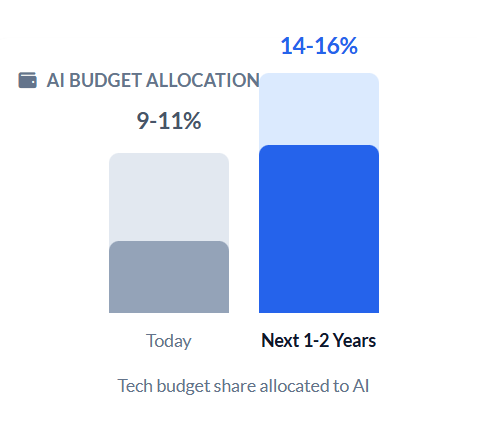
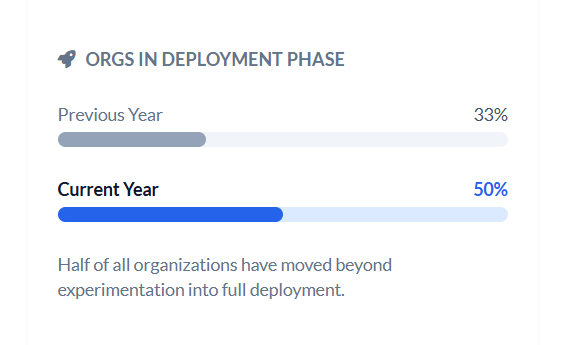
We’ve been tracking customer perspectives on AI through hundreds of NPS surveys and thought leadership research over the past two years. The narrative has shifted dramatically—from experimentation to deployment and scaling.
Two Prisms: Efficiency vs Transformation
Customers are viewing AI through two distinct lenses. The first is efficiency and service delivery enhancement—think process automation, operational improvements, productivity gains. The second is business transformation—revenue generation, market differentiation, new business models.
For service delivery enhancement, the approach is largely technology and process-led. Customers want ready-to-deploy, scalable solutions available on cloud platforms. For business transformation, they’re looking at strategic customization of AI to meet compliance requirements, responsible AI frameworks, domain context, and hard ROI proof.
The mood is shifting from technology to business. In our surveys, 55–60% now say identifying ROI-worthy business use cases is their top priority, compared to 50% focusing on technology use cases and PoCs 1–2 years ago.
And there’s a reason for that—the service transformation narrative is being served by hyperscaler-led infusion. Read: Copilot, AWS AI services, Google Cloud AI. More businesses are now discussing differentiation and revenue generation opportunities.

The Mindshare Battle
In our brand studies, when we ask IT decision-makers which AI services firms are top of mind, 45% interestingly call out hyperscalers like AWS, GCP, Meta, Azure—even though the cue is IT services. That tells you something.
In our deeper CSAT research with 70+ tech services providers, where we ask customers which firms are best positioned to lead the AI space and why, we see a similar but more nuanced view. 30–35% call out hyperscalers. 40% say IT service providers. 20% point to consulting firms. The rest mention niche or boutique firms focused on AI.
But more than this dispersion, the interesting insight is why they think so.
Hyperscalers are seen as able to bring scalable use cases already integrated into their services, which can be quickly aligned to customer businesses. These tend to be horizontal in nature—service delivery transformation.
Consulting firms and IT firms, on the other hand, are valued for their traditional knowledge of the customer landscape, domain expertise, industry context, and ability to customize AI solutions to specific business needs.
Where the Real Opportunity Lies
This tells us something critical about the opportunity for IT service providers. It’s not in service delivery and efficiency—that will get commoditized by hyperscalers and product firms like OpenAI, Google, Anthropic. The real opportunity is in business transformation, where hyperscalers struggle and where solutions are almost always non-standard and evolving. A product or platform approach rarely works here.
Yet, most conversations between customers, analysts, and IT service providers hover around efficiency. How much can you reduce resources? How much discount can you provide? My view is this is a distraction—though one you can’t completely avoid. The real opportunity lies in strengthening the fight for business transformation opportunities.
But there’s a traditional challenge: connecting with business stakeholders. IT service providers have historically worked with the IT organization. Consulting firms have an edge here because they come in top-down, and they’re now trying to build IT delivery powerhouses to capitalize on this shift. What’s needed is more domain focus, vertical expertise, training teams to be solution-oriented with the agility to handle complexity, and building AI solutions with vertical depth.
The Disconnect
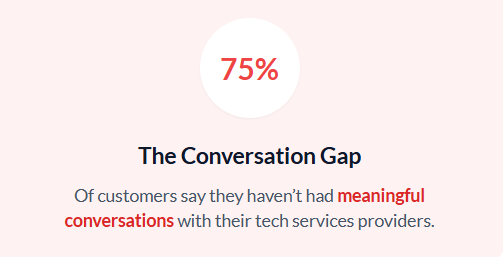
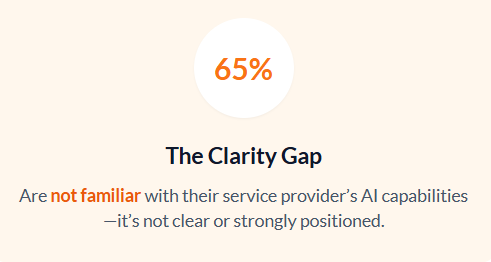
In this whole melee, IT services providers are trying their best to get in front of clients. But it’s not playing out well. We’re seeing in our surveys that most customers say they aren’t have meaningful conversations with their service providers – quantity is there but not contextual quality. Moreover, majority are not familiar with their partner’s AI proposition.
I’m not saying IT service providers should abandon delivery transformation or efficiency-led AI. Many customers are asking for help on data readiness, upskilling, co-incubation—41–45% want help from their providers on data readiness and integration programs.
But our minds usually default to what we’re familiar with. Service providers have always been great at implementing and executing plans—running the machinery rather than building new machinery, developing roadmaps, or venturing into uncharted territories. It’s not about capability. It’s about the models and structures built to scale execution, and people trained to follow processes.
The Pivot
This is a tremendous opportunity to pivot. Train people to spot opportunities, solve problems, create agile structures that align with business value streams quickly, and develop commercial models with reward and risk baked into it. In a way, this clearly connects to the saying that AI will not take away jobs but transform them. Hyperscaler-driven AI will take over maintenance and large-scale execution jobs. But it will create more opportunities for consulting-led engagements—smaller in size perhaps, but more frequent, more strategic, and more valuable.
The fog is clearing. The question is whether IT service providers will position themselves where the real opportunity lies.